
STANLEY PARK NOTEBOOK
/by Jacqui Birchall
(click images to enlarge)
American Wigeons. (Frank Lin PHOTO)
MIGRATING BIRDS
Some Leaving, Some Arriving
Now is the time for a major bird migration: our summer birds are heading south, while waterfowl and sea ducks arrive from the freshwater lakes and wetlands across the boreal forests and taiga of northern Canada and Alaska.
Stanley Park is designated as a globally significant Important Bird Area, serving as a vital sanctuary for more than 230 bird species. Its unique combination of freshwater lakes, dense coastal rainforest, and open marine shorelines makes it an elite birdwatching haven.
Because it is currently autumn, the park is in the middle of a major seasonal transition. Summer songbirds have departed, and massive flocks of wintering waterbirds and sea ducks are arriving from northern Canada and Alaska to settle in the park's milder waters.
Greater Scaup. (Frank Lin Photo)
On Lost Lagoon and Beaver Lake, look for American Wigeons, Green-winged Teals, Northern Shovelers, Scaups, and Hooded Mergansers with their oversized, collapsible crest.
English Bay, from around Second Beach to the Lions Gate Bridge, will be filled with Surf Scoters, Buffleheads, Barrow’s Goldeneyes, and Hooded Mergansers. An amazing sight, with hundreds of these very shy, diving, mussel-eating sea ducks. A group of these birds is called a raft.
Hooded Mergansers love Lost Lagoon, but you can occasionally spot them close to shore around the seawall from Second Beach to the Lions Gate Bridge.
Surf Scoters have black-and-white patches on their heads and huge orange bills. The Buffleheads are smaller, with black, white, purple, and green patches on the males’ heads. The Hooded Mergansers have a distinctive appearance, with huge black-and-white crests on their heads. They are stunning to look at.
Barrow’s Goldeneye males are black and white with a long white crescent on their face. The females have a huge yellow bill. They are very striking if you can photograph them.
All these incoming water birds and sea ducks are very shy, probably because their summering spots are so lonely. One will need a good telephoto lens to photograph them.
Hooded Merganser. (Frank Lin Photo)
If you want to know more, Stanley Park Ecology is offering a guided workshop titled “Scaup Zone and Scoter Friends: Guided Duck Walk.” Find links to this and other events and documents cited under “Related Links” below.
Have you noticed the colourful ducks splashing in the waters of the Salish Sea? Join this birding program to learn about common winter residents of Stanley Park such as the Lesser Scaup and the Surf Scoter (plus other birds nearby like American Wigeons, Common Mergansers, Wood Ducks, and more!).
Led by avid birder, wildlife photographer, and SPE Nature House Outreach Specialist Frank Lin, this walk will take participants to the seawall to admire flocks of birds in the waves and learn their identifying traits and seasonal behaviours. No birding experience necessary! Feel free to bring your own binoculars or borrow theirs. If the seawall is closed, the tour will admire the ducks at Lost Lagoon.
The summer birds that are migrating south, some as far as Mexico and Central America, include the Rufous Hummingbird (the Anna Hummingbirds stay, apparently enjoying feeders), the Swainson’s Thrushes, Yellow Warblers, Townsend Warblers, all the Swallows, the Flycatchers, and even the Ospreys. Birds that fill the trails with song.
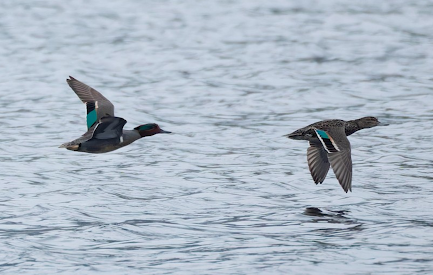
green winged teal. (Frank Lin Photo)
Have you noticed that four Common Ravens have moved from the depths of Stanley Park to the area around Gilford Street? Their call is very recognizable. Also, the Beaver Lake dwelling Steller’s Jays are hanging around Gilford Street too.
Remember, if you wish to identify bird sounds, download the Merlin Bird App and just press record. The Common Raven call is like no other, and once you recognize it, you will always know when these majestic birds are close.
NEWS FROM STANLEY PARK ECOLOGY
Congratulations to Stanley Park Ecology (SPE) on reaching and surpassing their matching-goal fundraiser. Late on October 20, SPE posted:
“Thanks to our community, 117 donations helped us surpass our $12,500 matching goal, unlocking more than $25,000 for Stanley Park’s wetlands. Even more exciting, over half of our donations came from new donors!
“Your support will help expand year-round monitoring at Beaver Lake and Lost Lagoon, building a clearer picture of wetland health and the wildlife these ecosystems support.
“What comes next? We’ll share our findings through public freshwater reports, helping our community understand these changing ecosystems and informing future conservation and restoration efforts.
“To everyone who donated, shared, and spread the word: thank you for making waves for Stanley Park’s wetlands!”
Last month, SPE staff enjoyed a beautiful October day restoring Stanley Park’s forest understory alongside the organizations community of volunteers.
With support from Tree Canada, 43 participants came together to plant 521 individual plants across 18 species, including native herbs, ferns, and shrubs. These plants help rebuild the forest understory, support biodiversity, and create healthier habitats for the wildlife that call Stanley Park home.
A huge thank you to Tree Canada / Arbres Canada for supporting this restoration work, and to everyone who spent their day getting their hands dirty for a healthier forest!
Stanley Park Ecology is offering many workshops and walks throughout November.
For families with young children, check out “Nature Trails” on November 14 & 15, 21 & 22, and 28 & 29 from 1:30 - 2:30 p.m. (this is a drop-in, by-donation program for families) and the Family Nature Walk: Autumn Scavenger Hunt November 21 from 10 - 11:30 a.m. Meet at the Nature House at 712 Lost Lagoon Path.
Plus many more in-person workshops/walks in the park in November. Learn about mushrooms, slugs, and fascinating, brainless eukaryotic organisms; Andean embroidery; Stanley Park’s trees; the newly arrived sea ducks; and forest fungi. Check the link below for full descriptions and how to register. The workshops frequently fill up in advance.
Coyote in stanley park. (Jacqui Birchall photo)
YOUNG COYOTES ON THE PROWL
I recently spotted three coyotes shortly after dawn on a Stanley Park trail. I was excited to see them, but they were very wary and headed into the trees. The following day, I spotted a fourth on another trail.
Stanley Park Ecology advises that during coyote dispersal season (typically running from September through November each autumn), young coyotes born in the spring leave their family territories to find homes and partners of their own.
During this time daytime sightings increase, which is completely normal, as young coyotes, inexperienced with urban neighbourhoods, green spaces, and parks like Stanley Park, wander around at unusual hours. They can be very curious as they learn survival skills and how to navigate humans and their landscape. As they mature, daylight encounters will diminish.
Daily sightings of the young coyotes can alarm some people. They are shy, not aggressive.
For advice on how to co-exist with coyotes, click on the co-existing with coyotes link below.
BEAVERS IN STANLEY PARK
Lost Lagoon Beaver. (Jacqui Birchall PHOTO)
Beavers live in both Lost Lagoon and Beaver Lake. They are crepuscular, so more likely to be spotted at dawn or dusk. Beavers have lodges in Lost Lagoon and Beaver Lake. The Lost Lagoon beavers have been busy building their regular dam, which delighted raccoons use as a bridge. See the video linked below.
By the way, have you heard what the beavers are up to on the River Thames?
Humans in the UK have finally discovered that the beavers’ ingenious dams are very useful. They have been reintroduced into certain London neighbourhoods after a 400-year absence to help control flooding with their dams.
Five wild beavers were released into the 24-acre urban site at Paradise Fields in 2023 to combat heavy rainstorms and tube station flooding. The population has since grown, building multiple dams that act as a natural sponge and reduce local flooding to zero in target zones.
In Enfield (North London), a male and female beaver pair were released into a six-hectare enclosure to help manage waterways, lower flood risks from extreme rainfall, and boost local biodiversity.
Beavers offer many benefits for Thames Flood Management: Their dams slow water flow after heavy downpours, protecting residential streets and public transit infrastructure. Water Quality: Research indicates that beaver-engineered systems can reduce pollution peaks in British waterways by up to 95%, making aquatic environments healthier. By building ponds and wetlands, they create vital habitats for fish, birds, amphibians, and insects. Granted legal protection in England in 2022, it is illegal to kill them or tamper with their dams and lodges without a proper license.
And for centuries they were killed!
park board commissioner and west ender tom digby.
THE NEW PARK BOARD
Congratulations to the newly elected Vancouver Park Board, and especially to the very hard-working Tom Digby, who received the most votes, 78,751. The Park Board now includes members of the Green and Cope Parties.
SEAWALL CLOSURES
The Vancouver Park Board advises that the Stanley Park seawall closure that began October 26 will continue through to November 14.
The seawall between Lumberman’s Arch and Third Beach will be closed. Temporary detour routes will be in place. Please follow posted signs and view our map for details.
Crews will improve safety and accessibility by removing speed gates and adding new measures to improve the flow of pedestrians and cyclists in high-traffic areas. This work is being coordinated with annual rock scaling and seawall maintenance activities to minimize disruptions for park users.
Thank you for your patience as they work to improve the seawall experience for everyone.
ORANGE CONES ON TREE STUMPS
If you have wondered about the proliferation of small, screwed-down orange cones on tree stumps throughout the park and city, the Park Board says they are there to keep folks from tumbling over the stumps. I think the orange cones are far more of a trip hazard! Spiky and immobile!