ARTISTS AMONG US
/ABIGAIL ROSCOE
A Vision of the Future
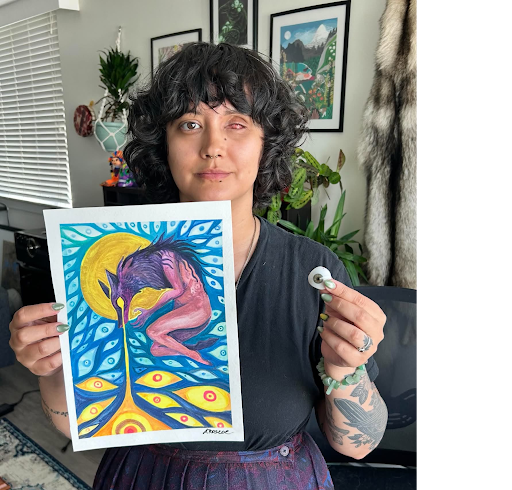
Abigail roscoe sporting a “support real art” eye-patch. (Michelle Livingstone Photos)
by Michelle Livingstone
(click images to enlarge)
She thrives whilst dealing with autism, arthritis, a stroke, and the loss of an eye. She wore racist slurs like badges of honour whilst finishing her degree in ‘Design/Illustration and Visual Communication’ in the Netherlands. She lived to tell tales of strange happenings in the farthest reaches of Norway, where realms collide and portals are wafer-thin.
She's an artist. A writer. An illustrator. A person with uncannily more vision for the future than most people have with two eyes. After surgery to extract her right eye in February of this year, following a “should be struck off Swiss doctor's advice” (my thoughts, not hers), Abigail Roscoe cuts more than a cool figure. She intensifies the area when you are with her. She reminds me a lot of her compatriot Huēhuehcoyōt, the unlikely hero of her new animated web series, ‘The Sixth Sun,’ available to watch on her YouTube studio channel, Coyote Studio.
Coyote depicted with human hands and feet: ‘Coyote Dancer in the Cosmos’
Huēhuehcoyōt, ‘old old coyote’ (pronounced wei-wei coyote), first appears in ‘Codex Borbonicus,' an ancient Aztec manuscript thought to have been produced around the time of the Spanish conquest, and is depicted as a dancing coyote with human hands and feet. He is the god of music, ceremonial dance, storytelling, and uninhibited pleasure—the modern-day life of the party. A much maligned and misunderstood animal that we have collectively tried to exterminate (and still do to an extent), Huēhuehcoyōt is one of the many trickster gods in mythology. It belongs to a pantheon of otherworldly entities, such as Loki, Hermes, Mercury, Dionysus, Bacchus, and Pan, all sharing similar attributes. Chaotic, creative, and joyful, they bring art, humour, dance, and wanton abandon to all who ask. Shape-shifters that shake up the norm.
Much like the coyote god she embodies, Abigail's artwork is as busy as it is brave. It speaks volumes; it is full of colour, and there is something to devour in every inch of paper, with very few blank spaces. This is how she sees the world: a beautiful chaos, a rhythm interrupted but not broken. I was honoured to be invited to her recent exhibition in Gastown; to me, her art melds hurt with hope. She acknowledges the two-headed monsters that are part of our deep psyche, and that we don't ever want to answer to. Embracing and understanding the overlooked, forgotten, and berated. Sometimes you need to step up and be the coyote: fearless, free, and fiery.
Abigail's paintings are rich with colour and energy: ‘Dawn of Huehuecoyotl’
Born in Medicine Hat, Alberta, to a Mexican mother and a Canadian father, Abigail discovered her passion for art early on. Her great-grandmother, also called Abigail, was a chronologist, historian, and folklorist who passed on her storytelling abilities and the roots of her Mexican heritage. Growing up between Canada and Mexico, Abigail had one foot in each.
Abigail found her inner coyote early and went to live in Groningen, the Netherlands, to do her degree; while there, she also learned how to deal with the first aspects of bigotry and racism, stemming ironically from one of her teachers. She tells the story of being introduced to her classroom on day one.
The professor—yes, the professor —pronounced loudly, “Oh, Abigail, you're the r——-ed one,” signalling Abigail's autism to the rest of the class. Not satisfied with the one nasty swipe at her new student, she followed up with, “What kind of brown are you?”
With far more control than I would have shown, Abigail didn't sass back; instead, she graduated as the highest in her class. Even though her classmates continually mocked and mistreated her, one even called her Consuelo, the cleaner in the Family Guy cartoon.
She didn't let it faze her.
During her time in Europe, she also lived with a Sami reindeer-herder family in northern Norway, where she wrote and illustrated a children's book. Whilst there, she encountered something otherworldly.
With a group of friends she had made, she decided to chase the Northern Lights in a van. Ending up close to the border of Finland, in the middle of nowhere in the Arctic, 35 below zero, amidst a silence you could smell and surrounded by foreboding, lurching trees on a little logging trail, a lone figure appeared from the woods, dragging a lawn chair and promptly sat in the middle of the road, blocking their way.
She says, “One of my friends was like, ‘Oh, he probably needs help,’ and I said, ‘Do not get out of that car. Get out of the car, and I think that we're all gonna be in a very different situation.’”
In agreement, and no doubt in fear, they decided to back up slowly, but the strange fellow in the chair kept shifting himself and his chair toward them. They managed to keep going and lived to tell the tale. She says she isn't sure whether it was a real thing or a bad spirit, but it inspired many of her other stories.
Art Reflecting Life, Life Reflecting Art.
Following from that, and I would venture a jolly good reason not to go to Norway looking for the Aurora Borealis, she tells another tale. Those pesky Northern Lights are, however, determined to show her something, and it isn't a light show.
“We decided to go more towards the coast because there are more people there; it's a little bit better and we end up on this tiny island that we literally had to drive on an underpass through and we realized there's actually nobody on this island at the time and so, we're setting up the photography equipment to take some pictures of the lights, and suddenly we cannot hear the camp fire; everything goes quiet and we all see that there's something looking at us from the bush and we were like ‘Oh, okay, all right, let's start packing our stuff.’”
Having now escaped two heart-palpitating situations, she decided it was time to head back to something bordering on civilization, and so she left her Sami family and headed to Switzerland to finish her bachelor's, where she met her now-wife, Liv, an audio engineer who collaborated with Abigail on the score and sound design for The Sixth Sun.
And in this neutral zone, a major setback would happen—Glaucoma and the eventual loss of her eye.
She explains that she went to the doctor's because she had inflammation in her eye and was prescribed a dose of very strong cortisone steroids to combat this; however, she had to leave Switzerland in a rush due to personal issues and so headed back to Canada with six months of the steroid, no follow-up or any help, with just a doctor's word on what to do. Keep taking it.
“My uncle is a retinologist,” she says, “so when I moved to Canada, I didn’t know what was happening with my eye yet. I went to visit family in Celaya, and my uncle told me I had glaucoma - we did a procedure called a vitrectomy, but it sadly wasn’t enough to save the eye. After I came back to Canada and could finally see a doctor here, I went through the wringer with them. It was procedure after procedure to try to save an eye I ended up losing.”
This piece is one of the author's favourites. ‘Guardian of Loss’
Due to the buildup of the very strong steroids, the blood flow to the eye cut off completely, and she ended up with a blood clot that caused a stroke, effectively wiping out any hope of sight thereafter.
But even in the darkest moments, creation is born—a beginning. Like spring after winter, she called on her inner strength, her coyote god, and rose to the newest challenge.
“Through the business that I'm trying to create - a production studio that also primarily employs other people with disabilities like myself. Because I feel like that's part of the change that I want to see. I notice that it's so difficult to sometimes have people treat you with the baseline respect of just being another human being when you're disabled. Some people even think of the word disabled as a dirty word. Some people even consider it a less than thing. But part of that for me is like the reclaiming of that. That it's like, well, I do have a disability. It doesn't make me.”
Abigail is no stranger to slurs and barbed comments on her social media platforms, where she openly and bravely talks about the loss of an eye, art, and life. I ask how she manages to keep dealing with the onslaught of trolls.
“I'm glad the block button exists. I mean, the thing is, if I pretend that that's not happening, maybe I have the peace of mind of not dealing with that. But then it's also like, no, I've got to, because I don't want my comment sections and everything to turn into a platform of hate. And also, by venting about it, it helps me to have people realize that that stuff's still going on. For example, if you're transgender, LGBT, if you're in any sort of minority group in general, you're always going to receive these horrible comments from people. Some folks might think, ‘Oh, we're beyond that,’ so they pretend it doesn't happen, and what I'm trying to do is show it does happen, but also that I can handle it.”
Abigail’s art-making is intrinsic to who she is; it is her purpose, her route through life; she passes her passion onto the young ones when she volunteers at Stanley Park. Earlier this year, she designed a class that not only let the children run free with their imagination, but also taught them about the art they were making. Instead of just drawing the animal, she asks why they might have certain features, and what they might be used for. A clever, absorbing way to spark interest. Something with meaning. Something that matters.
She says, “I was teaching them how to draw Axolotls. Those little frilly amphibians. They're actually very endangered right now.”
How wonderful it is to teach the young ones so they can be aware and, more importantly, care. And caring for the environment and each other is a huge part of Abigail's nature. And sometimes it seems we, as a species, have lost sight of who, what, and where we are.
Combining modern and mythical with ease: ‘Jaguar and Eagle’
She continues, “I think we've kind of diverged into hyper-individualism to the point where a lot of people don't really care about community building; they only really see themselves, and maybe at most, their friends and family. People are preoccupied with dissecting and analyzing and arguing rather than trying to find collaboration.”
Which brings us back to her animated series The Sixth Sun, which was kickstarted and reached its goal in an astounding 33 minutes. It tells the story of the Aztec prophecies regarding the first, second, third, fourth, and fifth sun.
“We're currently living under the era of the fifth sun,” she explains, “and the ending of a sun is essentially the ending of an era. The sixth sun will only happen if people can believe in themselves, so the whole point of the story is: does humanity have what it takes to create hope?”
While there is hope, there is also acceptance; only when we accept, can we move forward.
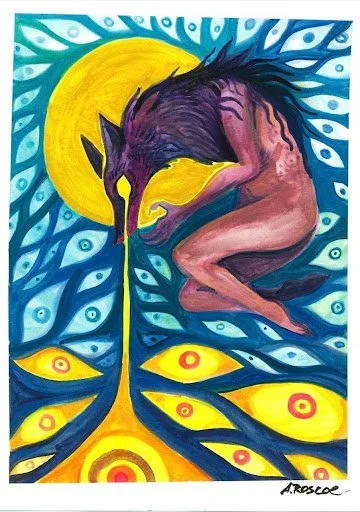
More than just a painting. Abigail's art strikes deep: ‘Phases of Grief’
“There are going to be things that we lose,” she continues, ”but we need to not sit in that grief. We need to protect what we can still protect. Because when you look at ocean acidification or the decline of old-growth forests, we can't make an old-growth forest come back. That process takes thousands of years. But what we can do is to protect what remains. If we can just skip the grief part and go into action, once we save the world, we've got time to grieve. We can't live in panic. We can move on and save what we can.”
Abigail has already produced a prolific body of work; beyond the animation series and gallery exhibitions, she has illustrated several children's books, including Yuka's Way Home, The Hugabunch Bear, and The Posse of Possums, with Zach Thomson in the writer's seat. She shows no intention of slowing down. Such is her energy and joie de vivre.
Meeting Abigail reminded me to always find colour in life. It's easy to be monochrome and not take part. To be passive in a world that moves so fast. We can and should, to the best of our abilities, follow our dreams; we have to, to balance out this topsy-turvy spherical mess we are currently spinning on at approximately 465.2 meters per second.
So take the chances, cause a sensation. Don't second-guess. Embrace your whole self. Sing loudly, dance in the street. Hug everyone you can. Wish everyone a good day. Always say thank you, and don’t forget the sunrise, sunset, and that devilish Wiley (Wei-Wei) Coyote within.
You never know where it might take you, but the ride will be worth it.