
STANLEY PARK NOTEBOOK
/by Molly Sheanth
(click images to enlarge)
BALD EAGLES IN STANLEY PARK
Powerful Birds and Powerful Symbols
It is midwinter in Vancouver and several bird species in Stanley Park are beginning their yearly courting and nesting rituals. One charismatic species currently in nest building mode, which you may have observed soaring high in the sky or perching in a tall tree near the sea, is the bald eagle (Haliaeetus leucocephalus). Several nesting sites can be found throughout the park, which are actively monitored by Stanley Park Ecology (SPE), work that was initiated in 2004 and which has documented 13 different nests over that period of time. However, it should be noted that not all nests are active in the same year.
The Douglas fir tree located beside the Malkin Bowl, which houses a bald eagle nest. (Molly Sheanh photo)
Bald eagles are a powerful symbol across many cultures, including xʷməθkʷəyə̓ m (Musqueam), Sḵwxwú7mesh ̱ (Squamish), and səlilwətaɬ (Tsleil-Waututh) Nations, who have been stewards of the land which is now known as Stanley Park for time immemorial. These birds of prey are called “masters of the skies” and are seen as messengers of good will between realms.
SPE provides the public with detailed scientific reports and resources about bald eagles residing in Stanley Park and the Lower Mainland. According to this information, these enormous nests are the largest of any bird in North America, and can be reused yearly by highly territorial breeding couples. Bald eagles tend to build their nests no further than 300m from a body of water to ensure a constant food source, usually high up in a tall conifer tree, below the crown, and snug against the trunk. Average nest measure 1-2m in diameter and can weigh one ton.
Bald eagles, as far as we know, mate for life. Their mating and courtship dances are quite elaborate and occur high up in the sky. This courtship can end in a “death spiral” with both eagles’ talons locked together while they hurtle toward the ground. These raptors will practice both courtship ritual and nest building skills long before they actually partake in these activities for real.
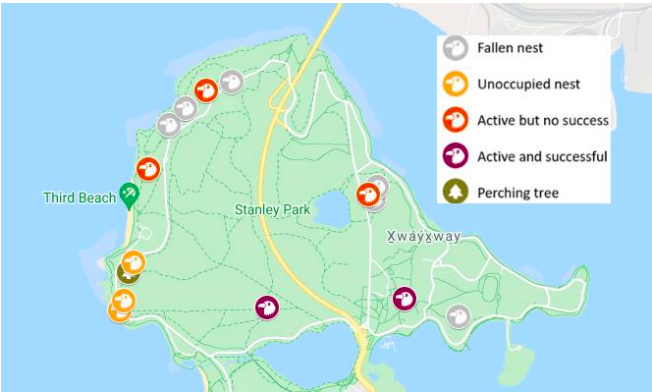
From a 2021 SPE report: Bald Eagle nest locations in Stanley Park from 2004 to 2021. (Stanley Park Ecology GRAPHIC)
Once paired, breeding couples can lay anywhere from one to three eggs per season, with parents taking turns incubating the eggs, and most chicks hatching during the months of March and April. However, not all eggs laid will produce successful hatchlings and not all hatchlings will successfully fledge when the time comes (usually in late June or early July).
On your next trip to Stanley Park see if you can spot a bald eagle nest! One of the most accessible nest sites is located near the Malkin Bowl, in a tall Douglas fir located to the east of the event space. It is unclear if this nest is currently active, but it is always good to keep in mind that giving breeding bald eagles and their eaglets lots of space and not causing them stress is highly important when bird watching.
INDOOR AND OUTDOOR EDUCATION IN THE PARK
If you’re looking for outdoor educational activities this February, SPE is putting on some exciting events throughout the month:
February 7 & 25 - Owl Prowl
February 11 - Senior Stroll: Winter Birds and Wildlife
February 22 - Birds of a Feather: Quacks and Flaps
February 28 - Winter to Spring: Watercolour Workshop.
Check out their website or subscribe to their events calendar for more details.
Axolotls are endemic to to the Valley of Mexico. The only wild population that currently exists is in Xochimilco, Mexico City. (Vancouver Aquarium photo)
If you prefer to stay mostly indoors this month, make sure to check out another charismatic species at the Vancouver Aquarium at the recently expanded amphibian exhibit Amazing Axolotls! for an immersive and unique experience.
This permanent exhibit launched in mid-January and features three habitats that seek to inspire and highlight the importance of wildlife conservation. The axolotl is one of Mexico’s most endangered endemic species, and its unique morphology and “perpetual smile” make it a great ambassador animal for conservation.
The exhibit blends “conservation, cultural significance, and wonder”and aims to educate visitors on the importance of biodiversity and global responsibility to all life forms, while celebrating international collaboration in conservation.