THE DRAGON'S PEN
/by Henry MacDougall
(click images to enlarge)
AN INTERVIEW WITH CONSTABLE VIVIAN QUACH
KG’s School Liason Officer Vivian Quach
Two years ago, the Vancouver School Board reversed the removal of the School Liaison Officer (SLO) program, reintroducing police officers in all VSB schools, including King George Secondary.
CONSTABLE Vivian Quach, School Liaison Officer at King George Secondary. (PHOTO COURTESY OF VIVIAN QUACH)
With the reintroduction of the SLO program, the role of a Vancouver Police Department (VPD) officer in school shifted greatly, transitioning from a more traditional police role to a revised one that focuses on helping students build good behavioural habits without harsh, at times legal consequences.
Now, two years after the program’s reintroduction, I got in touch with our school’s officer, Constable Vivian Quach. We spoke in back of the gymnasium, while a wrestling club meeting happened in the foreground, a program Vivian later explained she helped start with the assistance of a VPD grant.
Henry MacDougall: “What does your day-to-day look like on the job?”
Constable Quach: “When I come in to work, the first thing I do is I am in my office, around the Boundary and First Avenue area. ... When I get to KG, I usually check in with the admin and ask, is there anything I need to know? ... And for me, how I operate at KG is an open door policy for my office. I have it open pretty much every time that I am in the office, and you are more than welcome to come in, chat, ask me questions if people need help with their personal life or they want advice on school, things like that they can come say hi.
“I do a lot of outreach and initiatives for programs like this one here (gestures to wrestling meeting) the Dragon’s Groundwork Program is a grappling program. I wrote for a grant to get funding from the Vancouver Police Foundation to fund an accredited coach from a grappling gym to come in and once a week, he runs his program for students in grades 9-12. The program is free for all students. It’s a good opportunity for whoever is interested in this type of sport and don’t have the means to. So for example, when I came to this school I recognized that we were lacking this portion of our P.E. fitness department. We didn’t have wrestling mats. So I spoke to a lot of the staff members here about that, plus I observed a bunch of students who were getting into fights, getting injured on school property, outside of school, in classrooms. “
HM: “At KG?”
CQ: “At KG. And so I thought ‘We need to do this in a more controlled manner, and instil some discipline and respect.’ Having them come in each week to do this here has actually slowed down the amount of fights that have occurred here, which is good. Again, outreach and initiatives are a huge part of the job. I do that at the elementary schools as well.
“And then we also have a lot of resources as police that I think a lot of people don’t realize. For example, I might come across a student or a family that might be in need financially. They might need a little bit of help in terms of groceries, or if the student is really interested in cooking classes but they don’t have the funds to do that, we have grants that can help put students through these programs. There’s certain parameters, there are certain criteria that each family or each student has to meet, and you just write and apply for it.
“Maybe an SLO will build a relationship with that person, understanding what their interests are, what their means are, and then they can figure out how to get them there. So a lot of support, building relationships within the community.
“So not really my roles within each day, but also investigating anything criminal in relation to the school. So if a theft happens at the bike rack, that comes to me. Anything internal with the students, an assault, drug investigations, things like that, the admin will come to me, then we start the investigation from there.”
HM: “What motivated you to become an SLO?”
CQ: “Well, believe it or not, I wasn’t the best student. I didn’t like school very much, but what got me coming back to school were the programs that were offered, so like sports programs, volunteering opportunities, and clubs that I believed in. And then there were a select few adults in the school, teachers that showed that they cared. And that made all the difference to me.
“And I wanted to come back and do the same for you, because being a youth is the most impressionable time in someone’s life. If i just make one difference in one person’s life and give them opportunities they otherwise wouldn’t have gotten, and show them that I actually do care about them, and I want to support them, then great, I’ve done my job. That’s why I wanted to come back, because I had that influence as a kid, and without it, I probably wouldn’t have finished, right? So that was a big, big motivator for me to come to this job”.
HM: “And when you were in high school, was there an SLO present? And if so, how do you think that role has changed since you graduated and eventually got this job?”
CQ: “Yeah, there was an SLO for sure when I was in high school, but it was different in that city. Vancouver does it differently, where we actually have an office in the school. But at my school, it wasn’t like that. They had somebody who was assigned, and I’m not sure if it was just one person, or if it was a pool of people that were assigned to that school, and they would only come when asked to help investigate something or to do a presentation, so I didn’t really see them that much. I assumed that they would, you know, give me a ticket for something or whatever. So I would always think about that and not think about, oh maybe this person is actually gonna be able to help me through my high school years. So it was just very different.”
HM: “Finally, what is your favourite part of the job?”
CQ: “The outreach is definitely my favourite part. I get to meet so many different students, and you know at KG the community is so diverse. You have people from all walks of life here, and that’s the part that I enjoy the most, because it keeps everything interesting. I like meeting students and really getting to know what their interests and goals are, and how to get them there. That’s like the biggest part of my job that I enjoy. It’s super rewarding when you throw on a program like this, the wrestling club, and these students wouldn’t have the opportunity to do that if we hadn’t put it on here. So just doing all these little things is probably the best part. And also a bonus is that every day is different.”
THE INTERACT CLUB
The Sock & Toque Drive Finale
Park rangers Mario, Kevin, and Steve with KG Interact Club members and Ron Suzuki (Ron Suzuki Photo)
For the past few months the KG Interact Club has been conducting their fourth annual winter sock and toque drive in support of the Vancouver Park Rangers. The club collected essential warm clothing items like socks, toques, mittens, and scarves to be distributed to unhoused people living in Vancouver parks.
This February, the clothing items were finally handed over to Rangers Steve, Mario, and Kevin. These items will be distributed to those in need while officers are on duty.
WATER FOUNTAIN FOLLOW-UP
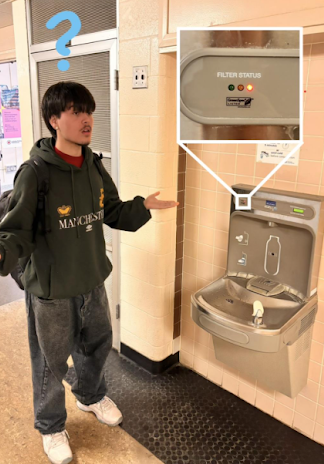
Returning to last month’s dive into KG water fountain concerns, the third-floor water fountain, known to be the only filtered water fountain at KG, is now showing a red light on its filter status. This indicates that the filter may no longer be effective for its purifying purpose within the fountain.
Bruno Guevara, who I previously interviewed, adds his thoughts: “I’m disappointed in the upkeep of this crucial fountain. I don’t know what the point is of having a filtered water fountain when the filter isn’t being replaced.”
OVERCROWDING AND ALTERNATIVES TO SPARES
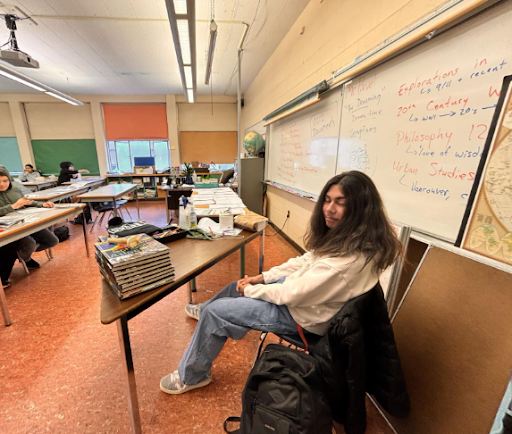
Rayhan, a COMMUNTY SERVICE STUDENT in Mr. Wilband’s Socials 9 course. (Henry MacDougall Photo)
Last month’s column discussed overcrowding as well as students’ difficulty switching courses due overcrowding of classes. Instead of just opting for a spare (as counsellors often suggest), one solution is to do Leadership, a course which operates outside of the regular class timetable. In Leadership, students are given a choice in how their course operates, with options such as peer tutoring, community service, and athletics.
These are opportunities for students to participate in community projects and see an impact around the school. Leadership can also work as a stepping stone or an experience for those students considering teaching as a career.
CLOSING NOTES
Spring Break: This year, Spring break will begin on March 16. Students will return to class on Monday, March 30.
Rose Grams: Once again, the student council sold rose grams this February as a fun way to spread love around the school. Along with a rose, students could send a message to the people of their choice, to be delivered during class.
Thanks for reading and have a great March, KG!