STANLEY PARK NOTEBOOK
/by Jacqui Birchall
(click images to enlarge)
KEEPING THE PARK CLEAN
Volunteer garbage pickers are the stars of Stanley Park.
See “Related Links” at the end of the article for links
to all cited documents and organizations.
Over the years, I have observed individuals deep in the trails with their pickers, buckets, or bags. I put out a call on social media for West Enders who clean the park to contact me, and the response has been very interesting.
Psychologist Byron Elton contacted me regarding how he takes patients suffering from trauma garbage picking on Staley Park’s trails. Why? Byron uses Eye Movement Desensitization and Reprocessing (EMDR) therapy to help patients suffering from trauma. EMDR is a type of psychotherapy in which Byron uses bilateral dual attention stimulation, in this case, side-to-side eye movements, to help the way memories are stored.
Parks workers clear the beaches of trash and debris. (Jacqui Birchall Photo)
I accompanied Byron on a garbage-picking walk in the beautiful Stanley Park trails. As one’s eyes search the ground for garbage, side-to-side eye movements are employed. Chatting with Byron, walking the trails, and picking up garbage are very healing activities.
Wren Den, another local resident, shared that, after noticing trash on her walks, she wanted to do something about it. She was raised with a stewardship and leave-no-trace ethos, and as Stanley Park is her backyard, she felt like she owed it to her community.
Wren Den started on the main trail, then meandered into the deeper trails, and it was incredible how much garbage there was. She felt it was less likely to get picked up and continued her garbage-picking activities for a year. Wren Den carried a garbage picker, a collapsible bucket, and gloves, but alas, she did not feel protected from the drug paraphernalia because of her running shoes. Amidst the human fluid and needles her feet and hands weren’t protected enough. She felt it was beyond her.
Wren Jen further shares that she cares about birds, and her dog-owning friends say there are not enough dog parks. She feels there are too many off-leash dogs on the beaches in June.
Jen Wren thinks she will do it again. She still has all her garbage-picking supplies
G. Gavin Gunhold, a West Ender who is a year-round swimmer, tells me he recycles beach and ocean garbage into art.
Laura Cat, an aquatic biologist, responded that she grew up in British Columbia and always loved the clean, beautiful lakes and rivers here. She could not fully appreciate what we have, though, until she travelled abroad and realized how special it is to drink directly from many of our natural water sources. As an aquatic biologist, she also cares about which chemicals are entering our water and how they affect biodiversity and ecosystem health. Laura explains that cigarette butts are among the most common forms of litter on earth, and whenever she sees them, she tries to pick them up from our public coastal spaces.
Laura further explains that cigarette butts leach chemicals like nicotine, heavy metals, and pesticides, and the filters add microplastics to the environment. Even one cigarette butt per litre of water has been found in some experiments to significantly harm small aquatic organisms. West End Community police have cigarette butt containers that Laura has shared with smokers.
Laura suggests that If you would like to get involved, OceanWise helps citizens organize or participate in their own shoreline cleanups in the West End.
OceanWise has some great cleanups scheduled, as does Surfrider, which has a cleanup at Third Beach on July 4.
The following clean-up groups listed in “Related Links” below are also worth checking into.
I have also met folks in Stanley Park whose companies or organizations give them time to clean up in the park. Please let me know in the comments section below who you are.
One day, while I was garbage picking on a trail, I saw very large collection of garbage, beautifully packed, left beside the trail in white garbage bags. When I investigated the bags, it was clear that a group had cleaned up an abandoned camp. The Parks folks confirmed it wasn’t them. Check the photo and let us know in the comments if it is your organization.
In conversation with Park Board chair Tom Digby, I learned that the Park Employees don’t remove people’s belongings from a discovered camp in the park. They clear only when the camp is abandoned, or a camp resident has found housing.
Michael Dowling has spent a lot of time cleaning garbage from beached vessels at Sunset Beach. He recently contacted me, wondering why the remains of a vessel are secured by a rope but not removed. He points out that the beached vessels are pollutants.
Clean-up of washed-up and/or abandoned vessels is a shared task that appears to complicate clean-up.
Removing abandoned or derelict vessels on Vancouver beaches is primarily the responsibility of the Canadian Coast Guard and Transport Canada under the federal Wrecked, Abandoned or Hazardous Vessels Act.
The removal process and specific jurisdictions are broken down below:
Garbage comes in all ‘ships’ and sizes. (Michelle Livingstone Photo)
Who is Responsible
Vessel Owners: By law, the original owner is fully responsible and liable for the costs of disposal or removal.
Transport Canada: Administers the Wrecked, Abandoned or Hazardous Vessels Act and manages the Abandoned Boats Program, which provides funding to local communities and organizations for the assessment, removal, and disposal of abandoned small boats.
Canadian Coast Guard: Steps in to remove or secure vessels if they pose an immediate environmental threat (such as leaking oil or fuel) or an imminent hazard to marine navigation.
Local Municipalities (City of Vancouver/Park Board): While they do not own the ocean floor or tidal waters, Vancouver city officials and park rangers coordinate with federal authorities to address public safety and debris cleanup when boats wash ashore on local municipal beaches (such as Sunset Beach or English Bay).
HOW TO REPORT AN ABANDONED VESSEL
If you spot an abandoned or wrecked vessel on a Vancouver beach, you should report it immediately to the proper authorities, depending on the severity of the situation:
Environmental or Safety Hazard: If the boat is actively leaking fuel or oil or poses an immediate danger, call the Canadian Coast Guard at 1-800-889-8852.
Local Beaches (Non-Emergency): To report a derelict or washed-up boat on Vancouver beaches, you can contact the City of Vancouver by dialling 3-1-1.
An email from the Vancouver Board of Parks and Recreation explained how staff clean the park and its beaches.
There are two distinct crews that work in and around Stanley Park, including the paper picker crew within the park and another crew that cleans all eight beaches. I frequently see the friendly paper picker crew at Third Beach early in the morning.
I chatted with one of the beach cleaners as they were working on English Bay early one morning. They shared that the particular crew works Friday through Monday and cleans the beaches from Third Beach to Spanish Banks and New Brighton Park. English Bay, they shared, is the most garbage-filled of all the beaches. This crew employs some seasonal workers.
There are crews that clean up portions of Coal Harbour within Stanley Park, as well as sections of Coal Harbour.
You may have observed the heavy equipment at Third Beach early in the morning as well. The Vancouver Board of Parks and Recreation reports that the log grappler moves larger pieces of driftwood while the screener picks up smaller debris. The beach screener thoroughly screens the sand of all debris from 3/8” (9mm) to 10” (254mm) in diameter. This includes rocks, seaweed, trash, and other unwanted debris that are returned to the beach. Anything larger is typically picked up by hand and either taken off-site or thrown in the trash. This equipment is used on the other Park beaches.
Maintenance crews clean up litter whenever it is identified during regular patrols or when travelling to job sites. At times, litter or large items are identified through 311, in which case crews are dispatched to clean up.
Sometimes items are too large for the small park garbage trucks. Larger items such as bicycle parts, shopping carts, or structural components of camps cannot be compacted in garbage trucks and must be recycled. In this case, park operations crews or park rangers are dispatched to remove these large items.
In answer to questions about dangerous garbage such as drug paraphernalia, the official response was as follows: " For any discarded needles or other paraphernalia, please contact 311 immediately. The exact location, street, trail, or landmark will be important to share. If there is urgency, like an overdose or erratic, unsafe behaviour nearby, call 911. It is important not to touch anything and ensure that children and pets are kept away.”
When asked about Parks’ crew safety, the answer was that the crews carry puncture-resistant sharps containers, gloves, and a paper picking stick, which operates much like an extended set of tongs. All staff are trained in safe needle handling, exposure prevention, and disposal procedures.
I enquired about the abandoned campsites, deep in the trails, full of garbage. Do the rangers still have time to investigate the trails and the off-trail spots where folks camp and light fires? Yes, they do, but it is all dependent on staffing levels and emerging priorities. Their investigations are led by a combination of proactive staff patrols and public feedback via 311.
NEW GARBAGE RECEPTICLES AT SECOND BEACH. (Jacqui Birchall Photo)
SHORT NOTES
REORGANIZING THE GARBAGE: A reader asked me to ask Park management about the reduced number of garbage receptacles along the Seawall around Second Beach. This is the response. The totes have been consolidated and batched for efficiency and aesthetics. Previously, they were spaced out individually, which made them appear strewn about. Staff determined that it looked somewhat unsightly and disorganized. Staff also noticed that, in their individual unsecured configuration, members of the public would either relocate them for their convenience or steal them, requiring staff to regularly recover or replace missing totes. The current system batches them, secures them in key locations, and gives the seawall a cleaner look.
(Jacqui Birchall Photo)
NEW FIRE ADVISORY SIGNS: The new fire signs in Stanley Park are an ingenious addition. They advise that if one sees or smells a fire, they should call 911 and tell the operator the three words on the sign. Each of the signs dotted around the park has three different, randomly chosen words. These words advise firefighters and park rangers, who are always notified of 911 fire calls in the park, where the fire is located.
MINI GOLF ANYONE? New Stanley Park Mini Golf Experience: The Park Board has announced that a new temporary mini golf course will open on July 1 at 10 a.m. at 690 Pipeline Road, the site of the Stanley Park Train. The Park Board promises nine beginner-friendly holes and nine more challenging holes. Advertised as family-friendly, the fees are $16 to $18 for nine holes and $23 to $25 for eighteen holes. Family packages are available.
The hours are 10 a.m. to 9 p.m. Sunday through Wednesday and 10 a.m. to 11 p.m. Thursday through Saturday.
Beyond the course, Stanley Park Mini Golf will host two re-occurring events: DJ Pablo Vynal nights, Thursday through Saturday evenings from 5 - 9 p.m. and Wonderland Weekends, Saturday and Sunday afternoons.
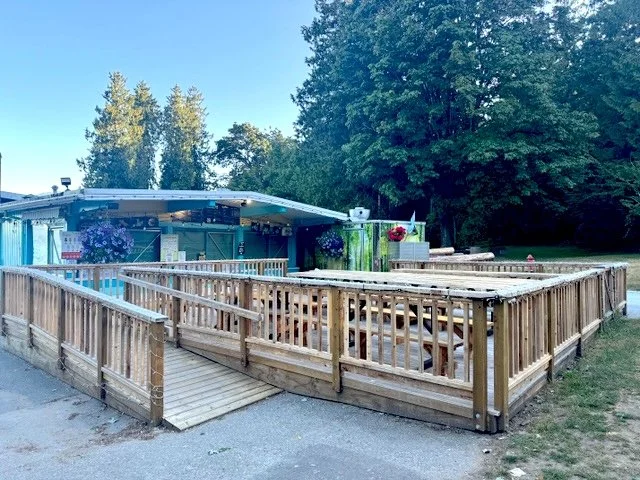
A new look at the second beach concession. (Jacqui birchall photo)
NEW CONCESSION STAND PATIOS: The new patio creations at the two concessions are very attractive. Be sure to check them out.
HERON COLONY NEWS: Stanley Park Ecology (SPE) recently announced that there are 73 juveniles in the Blue Heron Colony.
There is always something wonderful happening with SPE. Check their website for the latest.
CCGS Sir WILFRED GRENFELL. (S.V. Moore Photo)
SHIPS AHOY! Have you noticed this large, high-endurance, multi-tasked Canadian Coast Guard vessel primarily used for navigational aids, tending, search and rescue, and light station resupplies? It is named after the renowned medical missionary in Labrador. It operates out of Victory