
UNSUNG HEROES
/THE SASKATCHEWAN SHABBAT
Appetite, A Universal Wolf (W. Shakespeare)
by Michelle Livingstone
(click images to enlarge)
janice taylor.
A few weeks ago, in our wonderful West End, something special happened. Janice Taylor.
Fresh from the throes of a surprise separation, being made essentially homeless by her husband, and thus needing to re-home her mother who had lived with her for nine years, she was alone and wondering where life would take her.
Originally in Vancouver for a meeting, Janice was walking around enjoying the beauty and vivacity of our tiny town, when fate had her stop outside a building to read the vacancy sign. The manager just happened to be leaving as she was there and enquired if she was looking for a place to live, and the prairie girl found her new home.
She says, “I just took a big breath, like, okay, so this is where I restart my life.”
Within two weeks of finding her apartment and moving in, she posted an event on Facebook. The rules were clear. No politics, no phones, no Debbie downers, and in return she would make an Italian feast for her new West End neighbours.
You may find the title confusing, as it wasn't a typical Jewish shabbat, but having recently discovered that her grandmother was Jewish, something that was never mentioned to her as a child, in honour of her, and in honour of the families that fed her back home, the Saskatchewan Shabbat was born.
She says simply, “I missed people and I wondered if anybody wanted to come and eat”
Instead of sitting alone hugging a bottle of wine and staring into an empty carton of Ben and Jerry’s, Janice decided to invite complete strangers to her building's social room, and cook for them. No questions asked, no payment requested. Only an empty tummy and a happy heart. Initially the numbers were capped at 45, but word spread, excitement gathered and there were soon 70 people who craved what she was giving.
A herculean task, it wasn't just meatballs and pasta, as first touted. It became a behemoth of bruschetta, burrata, and baby tomatoes. Janice bought a wagon from Costco to bring home the growing list of groceries, which included 18 jars of tomatoes, ten pounds of penne, five pounds of spaghetti, 14 pounds of beef, six pounds of burrata, ricotta, mozzarella and salami, two litres of olives, one litre of sun dried tomatoes, five pounds of onions, 50 cloves garlic and a grana padano so huge, it could be classed as a weapon.
A FEW OF THE CREW SHARING A LOVELY EXPERIENCE
(Michelle Livingstone Photos)
Deciding she needed some help to prepare the menu, myself and a few others were only too glad to join in the fun. So on a sunny Friday afternoon, we congregated at Chez Janice and got to work making platters, stuffing lasagne, grating cheese, and laughing. Much laughing.
FOOD, THE LANGUAGE OF LOVE
Food, and the sharing of, is an intrinsic value of life, of where we began. Technology comes and goes, politicians rise and fail, humans continue to make mistakes, but ultimately, what we all want and need is food, our communal gel. Every human has used food, not just for survival, but as a gesture, a gift, a homage.
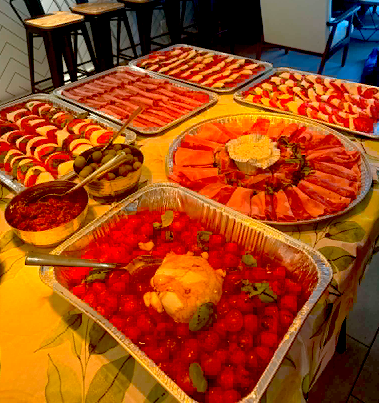
A LADEN TABLE OF HAPPINESS
Dr. Ara Norenzayan from the Department of Psychology at the University of British Columbia, writes, “Eating and drinking are a medium through which we gather, socialize, and create bonds. We celebrate, commemorate, tend to one another, and enact our rituals through food.”
Originally from Regina, in Saskatchewan, Janice was the proverbial village child. Her father was an addict who left home when she was six. Her mother had to work three jobs, which didn’t leave much time to attend to a young girl who had no idea why the world was like it was and who was going to help her shape it to her ideal. Relying on several families in the neighbourhood to take up the mantle, evenings were a beautiful mix of cultures that wrapped her in love, and kept her belly full.
“My favourite memory is the fact that I would literally travel to everyone's houses on different days to be fed and it was a family you know. I'd have a Cree family. I'd have a family from China. I went to a Pakistani family, German, Ukrainian, Polish. I would be at their tables and I got to learn all the different types of food, family, and cultures.”
CONVERSATIONS, CELEBRATIONS AND NEW FRIENDS.
She tells me why she decided to make that post.
“Mostly as an ode to where I've come from. I promised myself that if I did make it through, even that childhood and even the last year, and if I let it on my feet, that I was just going to decide that my own personal mantra of how I was going to live was just to give love. give love where I can, and if I do nothing else in the world, then that's enough. And so the reason I'm doing this dinner is that any injection of love is the greatest antidote for behaviour conditioning.”
As she grew into teenhood, Janice decided to change what she could and so took on a part time job at Dairy Queen to help with the bills. She held down another job at a local Rotary Club, at the same time excelling at three sports and smashing her exams, before finding her way into higher education and receiving an MBA in psychology.
BEING SOCIAL - WITHOUT THE MEDIA
After finishing university, and working in professional sports as her first start up, she spent time in Silicon Valley and was horrified by the dumbing down of people by social media. Knowing there had to be another way, she sought to create a solution to the social media addiction.
She says, “Silicon Valley built everything to keep people in the bottom half of the pyramid. Pavlov's dog conditioning is not good for humans. They literally made our push notification a bell. The number one problem in the world is the amount of behaviour conditioning in social media. It has changed how people see themselves, how they heal, and how we see each other. It has changed how we view love. From a theoretical point of view, it is the most toxic, dangerous thing that's ever happened to humanity.”
She cites that there are 100 million drug addicts in the world - indeed, an obscene and unhappy amount. But the number of people addicted to social media currently stands at 5.8 billion. Let that sink in. Thus indicating a far more insidious drug for which there is no cure, as yet.
Janice opines: “People legitimately spend more time inside of a behaviour conditioning machine than any heroin addict would ever spend on heroin. So I wrote a theory on the science of emotional pain. I wanted a different approach to how we saw the circumstances of our lives. In psychology we have something called the Diagnostic Statistical Manual, where you take the symptoms, plug them in, and then this could look like you have this quote-unquote disorder diagnosis. I felt that was too limiting to the human experience, I needed to write a science for a new category of wellness called emotional fitness.
“I looked for the common patterns and how people saw themselves. I looked at human addiction. I looked at everything from Aristotle to Descartes. I looked at the Bible. I looked at the Torah. I looked at how Buddha thought of the world. I looked at all the cycles. And I asked, what are they all trying to say, albeit differently? I worked at a recovery house and a lot of the women had been from the sex trade and had been heroin or meth addicts. I've also worked with some of the most famous athletes and movie stars. They're exactly the same. There's no difference between them. And that's when I was really able to isolate the emotional system as its own thing, separate from mental health. Essentially, what I discovered was that everyone's calling and purpose is present in the first ten years of life.”
ENTER WILSON4Q
THE ORIGINAL WILSON. (THANKS TO STEFFEN PIHL AT PINTEREST.)
Named after the anthropomorphic character in Cast Away, the deflated and bloodied volleyball on a deserted island, goes some way to explaining the human need for social interaction. It is what makes us tick, it keeps us alive. According to Maslow’s hierarchy of needs, people have five fundamental motivations; physiological, safety, social, esteem, and self-actualization. Beginning at the bottom where the essentials to life are food and warmth, we supposedly work our way up the rungs of the triangle. Rarely though do we reach the top, spending our time relentlessly treading water in the bottom half.
“I had to make Wilson, because I needed to show people and reflect people back without talking about the very thing that they're looking at, which is their very painful data and their purpose data at the same time. It is the best representation of how healing and human discovery should be. And if you think about the hero's journey in that way, every person really is on their own island, they have their own calling, they have their own journey, they have their own data, they have their own adventure to take, but unfortunately the way that our world is created is with hyper-codependency, hyper-dependency and behaviour conditioning.”
It took 30 years for Janice to write the science, after which she wrote an approach to prove it worked, and finally created an AI technology which looked at human data and patterns in real time. She put 2,000 patients through the theory. Currently at Harvard, she is doing the graduate studies of that work to prove that emotional fitness is its own category of wellness, between mental and physical health.
She now has people coding the app, which is due for release in September of this year.
Janice continues: “AI is only as good as what you train it to be. If you give it garbage, it will spit out garbage. If you give it everything, it will spit out everything. So that's why large language models are a disaster for humanity and why they're a disaster for the planet. They're built to know nothing and everything at the same time. It's an impossibility, and that's not how humans function. I needed to make something that didn't ruin the planet, that is what we would call verticalized, small language. Wilson is a small language AI technology that is perfected on the theory that when it's looking at something, it only needs to know you. It wouldn't compromise humans, wouldn't compromise our planet, wouldn't compromise our privacy, but would just work for you. Think of Wilson as an operating system for your life. You download it, you put in your unique flavor, and it will give you your unique story back.”
Given the opportunity, Janice says if she had a magic wand she would also solve the downtown eastside crisis. With a little help from Wilson.
“I would scratch every program they have. I would start from the beginning and say, okay, here's the root cause. Here's what we know to be true. Growing up in that environment - certainly not to that degree - is the most enabled codependent space that we have on repeat. You're just trying to manage folks, keep people alive. Everybody's doing the best that they can. That is all true. But if anything didn’t need any more band-aids, it's that space. I would literally create the most giant white board you'd ever possibly imagine and we would look at it with completely fresh eyes. Wilson4Q should be utilized first before you decide you have a mental illness or mental health issues. If you don't address the emotional system, which is agnostic, people will have symptoms of something that will look like disease and disorder.”
TIME TO EAT, LAUGH AND LOVE.
This powerhouse of a woman has three tech start ups behind her, is an author, a motivational speaker, was named as one of the Consulate General of Canada’s 12 Extraordinary Women in Tech, and appointed as an Honorary Captain of the Royal Canadian Navy in 2020. And she managed to pull this gargantuan dinner off! She reminded us of what we’d been missing, a sense of community, of sharing, of self worth. It seems so easy in hindsight, but it took a prairie girl with a huge heart and some very big pans to make it happen. All were well fed, and had a wonderful time connecting with their neighbours and making new friends. And the extra food did not go to waste, it was taken to the Salvation Army for any other souls that needed love and comfort.
“We are in a society of needing to prove love and earn love. You need to be something, you need to solve things. I have a saying, ‘You are loved by your breath and everything else you do is gravy’. It's just gravy, you are the meat and potatoes. You're already loved, you're already the whole meal, but people genuinely don't know that in their being, they look for outside validation. Right here, right now, this moment, joining that Facebook group, feeding people. It doesn't get any better than this.”
Janice fed us that night. She fed us love and kindness. And that is true food for the soul.
Learn more about Janice and Wilson4Q here and watch out for the next Saskatchewan Shabbat, coming to you soon, with love.