A CLOSER LOOK
/ROBERTS ANNEX SCHOOL AND SURROUNDING
TREES SLATED TO BE REMOVED
83 Trees In And Around Nelson Park On The Chopping Block
ROBERTS ANNEX SCHOOL AND SURROUNDING TREES SLATED TO BE REMOVED.
by John Streit
(click images to enlarge)
Whenever there is a major construction project in Vancouver, trees not placed behind a protective fence covered with orange plastic wrap are usually removed. A comprehensive tree mitigation plan must be created by developers in conjunction with an arborist and signed off by city staff. West Enders have seen many old and beautiful trees lost over the years as new buildings are built, but the scope of tree felling that will be happening at Nelson Park later this year when BC Hydro begins site preparation for the West End Substation Project has at least one community group concerned about the loss of a dense, healthy and longtime greenspace in our neighbourhood.
On its West End Substation website, BC Hydro says “while designing the substation and planning for construction, we’ve aimed to minimize tree impacts wherever possible.” The utility says it expects a maximum of 83 trees will be removed from the Nelson Park block. This includes 38 from the Lord Roberts Annex property to make way for excavation, 15 from the park because they are within the power line right of way, and 30 from the boulevard to provide space for safe and efficient construction.
Michael Thicke with the Lord Roberts Annex/Seaside Parent Advisory Committee says BC Hydro plans to remove 95 per cent of the trees on site. “The most recent tree management study shows that only two trees on site will be retained, but these are marked for possible removal pending the construction plan. Most of the street trees along Nelson Street will also be removed. These trees will not be replaced on site - there is some vague commitment to pay to plant new trees to replace them somewhere ‘within Vancouver’” he tells TWEJ.
SITE MAP OF 83 TREES SET TO BE REMOVED AT NELSON PARK. (BC HYDRO MAP)
BC Hydro says it is adjusting construction plans and protecting the bigleaf maple tree just east of the corner of Nelson and Bute Streets, which was originally slated for removal. “Throughout planning, we’ve explored opportunities to limit impacts to trees, and we heard from the community that this large, mature tree is especially valued,” Hydro writes. It adds qualified arborists will be monitoring the health of the tree through construction which is expected to be completed by 2032.
HYDRO PROMISES TO PRESERVE THIS BIGLEAF MAPLE .
Thicke and his PAC have been asking Hydro to reconsider their design to save as many trees as possible, especially on the edge of northwest Nelson Park. “Our concern with the permanent loss of trees on site is a loss in green space and natural environment for the children. Another important consideration is that trees provide shade - the new school to be almost entirely concrete or artificial surfaces which will overheat. We have also asked that they replant on site any trees that are removed. Again, this would require some change to the design but is quite possible if we can get commitment from the team to prioritize the environment for the students. This is also aligned with the recommendations in the letter to the design team from Vancouver Coastal Health regarding green space,” he says.
In that 2017 VCH letter to BC Hydro, the City of Vancouver, VSB and Park Board which Thicke cited, Chief Medical Health Officer Dr. Patricia Daly wrote “access to greenspace and natural environments is beneficial for physical and mental health. The Stantec report suggests that there may be a net loss of greenspace as well as removal of several trees from all sites to complete the proposed works.
NELSON PARK BOULEVARD TREES SLATED BE REMOVED.
Park space is already limited in the two neighborhoods. Careful redesign of the greenspaces will be required so that they can best serve all users in the neighborhoods. As well, shade trees are important to offset urban heat island effects.” Recommendations included maximize the space left for greenspace (as opposed to paved areas), work with stakeholders to design greenspaces that are considered “quality” greenspace, consider tree selection in re-planting in order to achieve similar canopy cover and if canopy cover cannot be replaced via re-planting, shade structures should be designed and installed.
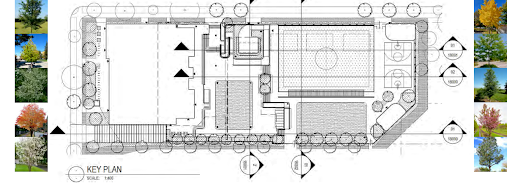
NELSON PARK TREE REPLANTING PLAN. (BC HYDRO PLAN)
On its website, BC Hydro outlines its “draft replanting plan” after construction on the West End Substation is complete. Forty-five trees will be planted on the Vancouver School Board property where a future Lord Roberts Annex is set to be rebuilt (more on this in the June 2026 edition of “A Closer Look” - link below). According to the utility, those trees include field maple, Turkish hazelnut, black hawthorne, katsura tree, Pacific dogwood, ginko tree, thornless honey locust, black gum, kwanzan cherry and pondersa pine.
Thicke says the PAC has a straightforward request. “Retain mature trees wherever possible and ensure that replacement trees are replanted on the school property and surrounding park space. While this may seem like a modest ask, it is deeply important to those of us who live near and around the park to have assurance that the community’s green space will be preserved and restored,” he says.
NELSON PARK MONKEY TREE APPEARS TO HAVE MADE THE CUT.
Vancouver Park Board Chair Tom Digby had no comment on BC Hydro’s tree mitigation plan but tells the West End Journal “we are very sorry to see the trees removed but staff worked with BC Hydro to minimize losses.” He adds a bigger concern for the Park Board is the amount of community garden space that is being lost. “I am bringing a motion with Commissioner Brennan Bastyovansky to find more community garden space inside Nelson Park to accommodate displaced gardeners. This will be heard at our meeting on July 28,” Digby says.
BC Hydro says it is funding replacement of the Nelson Park trees and street trees at a 1:1 ratio and working with the City on where those new trees should be planted.
Anonymous multi-coloured letters have been posted on trees along Bute across from Roberts Annex both lamenting the looming loss of trees and critical of a temporary bike lane set to be installed during the construction period. They read “The current plan to route a bike lane next to this west sidewalk is DANGEROUS to the community. The Bute bike lane is a very busy route with many electric-powered bikes/scooters travelling at high speeds. Moving the bike lane off the road and immediately next to a crowded walkway is an unsafe solution. It will create a bottleneck that puts all riders and pedestrians at risk.”
The letter adds “The removal of these beautiful 100-year-old Plum and Cherry trees is completely UNNECESSARY and the further loss of shade, wildlife habitation and annual blossoms will have a major negative impact on neighbourhood enjoyment and health.”
The unsigned letter encourages concerned readers to directly email BC Hydro at westendsub@bchydro.com.
Thicke maintains the current trees need to be preserved as they help make Nelson Park such a unique place in the West End.
TREES SLATED TO BE REMOVED ALONG BUTE FOR BIKE LANE.
“We love it because it’s walkable and bikeable and close to amenities. There are some tradeoffs - families here don’t have backyards. We rely on the small amount of green space per capita - it’s well loved and heavily used. The trees have been there for decades and continue to nourish and enrich the lives of the children and community and support wildlife. Children climb the low branches or sit in the shade they offer while reading a book. Recently the trees on the edge of the site were in full blossom, which is a beautiful way to start the spring. There is a lot of research out there pointing to the importance of green space to children’s development, and benefits to learning. The Lord Roberts Annex grounds are a haven in Canada’s densest neighbourhood. The fact that the West End can support so many residents while retaining a charm and calm that is missing in many other of Vancouver’s neighbourhoods is due at least partially to the many mature trees that line the streets and grow in the relatively few parks or planted areas. The loss of these trees would be a significant loss to the neighbourhood and to the students.”
_____________________________________________________________________
West Ender John Streit has been a B.C. radio, TV and online journalist
for more than 25 years. You can listen to John anchor
Global News weekday mornings on 730 CKNW Radio in Vancouver.